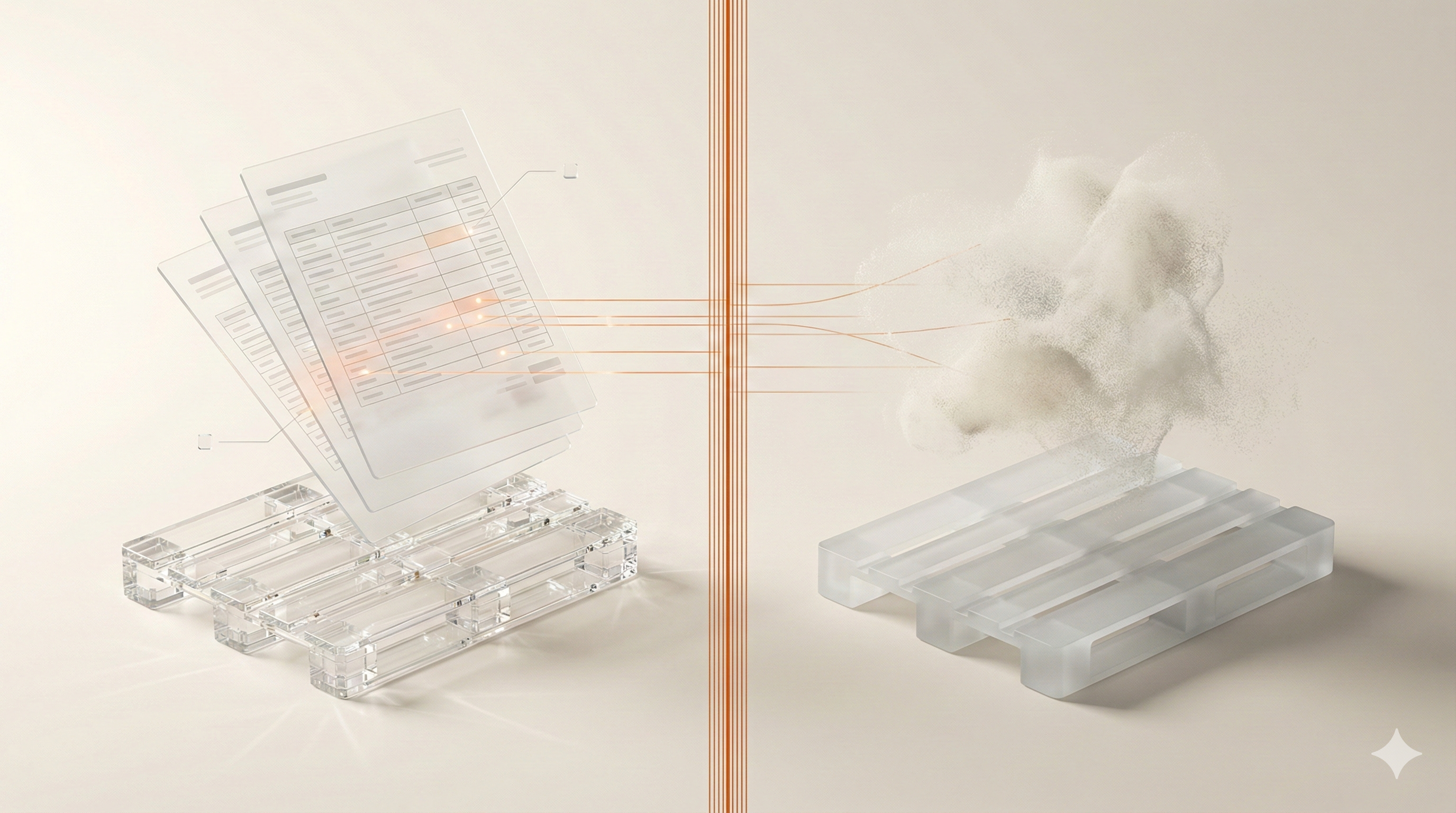
The Fundamental Tradeoff
Every liquidation buyer eventually faces this decision: pay more for a manifested load where you know exactly what you are getting, or pay less for an unmanifested (mystery) load and hope for the best.
A manifested load comes with a detailed spreadsheet listing every item inside the pallet or truckload. You get SKUs, descriptions, quantities, retail prices, and usually condition grades. You can research the items before you bid, estimate your recovery, and build a selling plan before the pallet even arrives at your door.
An unmanifested load gives you a category label at best. “General Merchandise Returns” from a major retailer. Maybe a rough item count. Maybe not even that. You are buying based on the source, the category, and your own experience with similar loads.
The tradeoff is straightforward: information costs money. The question is whether that information is worth what you pay for it.
What You Are Actually Paying For
The price gap between manifested and unmanifested loads is significant. Here is what typical cost structures look like across the industry:
| Load Type | Typical Cost (% of Total MSRP) | What You Know |
|---|---|---|
| Manifested pallets | 25-40% of MSRP | Full item list, conditions, quantities |
| Unmanifested pallets | 10-20% of MSRP | Category, source retailer, maybe item count |
| Mixed unmanifested truckloads | 5-15% of MSRP | Very little beyond weight and category |
A manifested pallet with $3,000 in total retail value might cost you $750-$1,200. That same mix of products, unmanifested, might run $300-$600. The difference — $450 to $600 in this example — is the price of information.
But raw acquisition cost is only half the story. What matters is the spread between what you pay and what you actually recover after reselling. And that is where things get interesting.
A Side-by-Side Example With Real Numbers
Let us walk through two realistic scenarios that a reseller might face in the same week.
Scenario A: Manifested Pallet
- Purchase price: $800
- Manifest details: 45 items, $3,200 total MSRP
- Category breakdown: 60% electronics (Bluetooth speakers, earbuds, small appliances), 30% home goods (kitchen gadgets, storage), 10% apparel
- Condition mix: 15 New, 20 Like New, 10 Used/Open Box
- Cost as % of MSRP: 25%
With this manifest in hand, you can estimate recovery before bidding:
| Category | Items | Est. Sell-Through Rate | Avg. Recovery (% of MSRP) | Expected Revenue |
|---|---|---|---|---|
| Electronics (New/Like New) | 20 | 80% | 55% | $844 |
| Electronics (Used) | 7 | 60% | 30% | $134 |
| Home Goods | 14 | 70% | 40% | $269 |
| Apparel | 4 | 50% | 25% | $40 |
| Totals | 45 | $1,287 |
Now subtract the costs of actually selling those items:
| Cost | Amount |
|---|---|
| Acquisition | $800 |
| eBay/marketplace fees (~13%) | $167 |
| Shipping (avg. $5.50/item sold, ~32 items) | $176 |
| Packaging materials | $30 |
| Total costs | $1,173 |
Expected profit: $114 on the low end, up to $450 on a good sell-through month. The realistic midpoint is around $280. That is a 35% return on your $800 investment, and you knew roughly what to expect before the pallet arrived.
Time investment: approximately 12-15 hours to photograph, list, pack, and ship over 2-3 weeks.
Scenario B: Unmanifested Pallet
- Purchase price: $350
- Listed as: “General Merchandise Returns” from a major retailer
- Known details: Approximately 40-60 items, mixed categories
- Cost as % of MSRP: Unknown (typically 10-20% if contents are average)
Without a manifest, your range of outcomes is much wider:
| Outcome | Probability | Revenue After Fees/Shipping | Profit |
|---|---|---|---|
| Great pallet (high-value electronics, mostly new) | ~15% | $1,100-$1,400 | $550-$850 |
| Good pallet (decent mix, normal conditions) | ~40% | $650-$900 | $150-$400 |
| Average pallet (lots of low-value, some damaged) | ~30% | $400-$600 | -$50 to $100 |
| Bad pallet (heavy/oversized junk, high damage rate) | ~15% | $150-$350 | -$200 to -$100 |
Expected value (probability-weighted): roughly $230 profit. But the standard deviation is enormous. You could make $800 or lose $200 on any given pallet, and you will not know which until you open it and spend 10+ hours processing it.
Time investment: 10-18 hours (higher variance because you cannot pre-plan your listing strategy).
The Comparison
| Metric | Manifested ($800) | Unmanifested ($350) |
|---|---|---|
| Expected profit | ~$280 | ~$230 |
| Profit range | $114 to $450 | -$200 to $850 |
| ROI (expected) | ~35% | ~66% |
| Risk of loss | Very low (<5%) | Moderate (~15-20%) |
| Time to process | 12-15 hrs | 10-18 hrs |
| Profit per hour | $19-$37/hr | $13-$47/hr (if profitable) |
| Predictability | High | Low |
The unmanifested pallet has a higher expected ROI percentage because the acquisition cost is so much lower. But the manifested pallet delivers more predictable dollars with less risk. Over 10 pallets, the manifested buyer can forecast their month. The unmanifested buyer is rolling dice.
When Manifested Loads Make Sense
Manifested loads are the right choice in several clear situations:
You are new to reselling. If you are still learning which items sell well, what condition grades actually mean, and how to price things, a manifest is your training data. You can research items before they arrive, learn what sells and what does not, and build your knowledge base without gambling your capital.
You specialize in a category. Electronics-only sellers, for example, can scan a manifest in minutes and immediately identify the items worth bidding on. If a manifested pallet has three $150 Bluetooth speakers in New condition and the pallet costs $600, you already know the math works. Specialists extract outsized value from manifests because they can evaluate items faster than generalists.
You need predictable cash flow. If reselling is your primary income or you are building a business with employees and overhead, you cannot afford a string of bad mystery pallets. Manifested loads let you project revenue for the month and make commitments based on realistic numbers.
You operate at higher volume. When you are processing 10-20 pallets a month, consistency compounds. A manifested approach might yield $280 per pallet reliably, giving you $2,800-$5,600 monthly. An unmanifested approach at the same volume introduces enough variance that one bad week can wipe out two good weeks.
When Unmanifested Loads Make Sense
Unmanifested loads are not just for gamblers. They make strategic sense in specific situations:
You run a bin store or flea market booth. If your business model is selling everything at a flat $5 or $8 per item, knowing the exact contents matters far less. Your margin comes from volume and low acquisition cost, not from optimizing the price on each individual listing. At $350 for 50 items, your cost per item is $7 — and if you sell 35 of them at $8 each, you have made $280 minus the pallet cost of $350… which means you need to sell closer to 44 items to break even. The math is tight, but bin store operators with foot traffic make it work through volume.
You have established multi-channel selling. Experienced operators with eBay, Amazon, Facebook Marketplace, Mercari, and local outlets can move a wider variety of items. When you can sell almost anything somewhere, the risk of getting stuck with unsellable inventory drops significantly.
You can absorb occasional losses. If your operation is profitable enough that a $200 loss on one pallet is an annoyance rather than a crisis, the higher upside potential of unmanifested loads becomes attractive. Over 20 pallets, the variance smooths out and the lower acquisition cost starts to show up in your aggregate numbers.
You process fast. Speed is the hidden multiplier. If you can unbox, test, photograph, and list a mystery pallet in 6-8 hours instead of 15, your profit per hour on unmanifested loads improves dramatically. Experienced operators with systems in place have this edge.
The Hidden Costs Most People Miss
Whether you buy manifested or unmanifested, there are costs that do not show up in the simple profit calculation:
Dead inventory. On a typical pallet, 15-25% of items may never sell at any reasonable price. Damaged goods, obsolete electronics, clothing in odd sizes, items missing parts. With manifested loads, you can estimate this before buying. With unmanifested loads, you discover it after you have already paid and spent hours processing.
Storage costs. Slow-moving inventory takes up shelf space, garage space, or warehouse space. At $1-$2 per square foot per month for storage, a pallet’s worth of dead inventory sitting for 6 months can eat $200-$400 in hidden costs.
Return rates on your resales. Even after you sell an item, 5-10% of your sales may come back as returns, depending on your platform and category. Electronics have higher return rates. Manifested loads let you factor this in; unmanifested loads do not.
Oversized and heavy items. A mystery pallet that turns out to contain three 40-pound printers sounds great until you calculate shipping at $25-$45 each. Your margin evaporates on items where shipping exceeds the resale value.
Your time. This is the biggest hidden cost. If you spend 15 hours processing a pallet and net $230, you earned $15.30 per hour. A manifested pallet where you can pre-plan your workflow and skip items that are not worth listing respects your time more efficiently.
The Hybrid Approach
Most successful liquidation operators do not choose exclusively between manifested and unmanifested. They use both strategically.
A common approach is an 80/20 or 70/30 split: the majority of your purchasing goes to manifested loads that form the predictable base of your business, while a smaller allocation goes to unmanifested loads as high-upside plays.
Here is what that looks like in practice with a $3,000 monthly buying budget:
| Strategy | Monthly Spend | Expected Profit | Profit Range |
|---|---|---|---|
| 100% Manifested (4 pallets @ $750) | $3,000 | $1,120 | $800-$1,400 |
| 100% Unmanifested (8 pallets @ $375) | $3,000 | $1,840 | $400-$3,200 |
| 80/20 Hybrid (3 manifested + 2 unmanifested) | $3,000 | $1,300 | $700-$2,000 |
The hybrid approach gives you a higher expected return than pure manifested, with a much tighter downside range than pure unmanifested. You get the stability of knowing your manifested pallets will cover your baseline costs, plus the upside potential of mystery loads without betting the whole operation on them.
Start with the 80/20 split. As you gain experience and build faster processing systems, you can shift toward 70/30 or even 60/40 if your results support it.
How Data Changes the Equation
The manifested-vs-unmanifested decision used to be purely about risk tolerance. That is changing.
Manifest analysis tools — including platforms like Liquidata AI — now let operators evaluate manifested loads in minutes instead of hours, scanning item lists against real-time market data to estimate actual recovery values rather than relying on MSRP. Some tools can even generate estimated manifests for unmanifested loads by analyzing historical data from the same source and category, narrowing the uncertainty gap. As these tools mature, the information advantage that justified the manifested premium shrinks, and the economics of both approaches shift.
The Bottom Line
There is no universally correct answer. Manifested loads trade higher acquisition cost for lower risk and predictable returns. Unmanifested loads trade uncertainty for lower cost and higher potential upside. Your right mix depends on your experience level, selling channels, risk tolerance, processing speed, and how much capital you can afford to tie up in inventory that might not move.
Run the numbers on your own operation. Track your actual recovery rates, your time per pallet, and your dead inventory percentage. After 10-15 pallets of each type, the data will tell you your optimal split more accurately than any general advice ever could.